-
☕
-
🍘
-
🧹
鄙事多能
The phrase originates from the Analects of Confucius. In the Zi Han chapter, Confucius reflects on his youth: ‘When I was young, my status was humble; thus, I mastered many practical skills.’ Having faced hardship early in life, he learned various everyday tasks to survive. The idiom honors the practical wisdom born of modest beginnings—expressing versatility with quiet humility.
太宰問於子貢曰、夫子聖者與、何其多能也、子貢曰、固天縱之將聖、又多能也、子聞之曰、太宰知我者乎、吾少也賤、故多能鄙事、君子多乎哉、不多也
Confucius (孔子), The Analects (論語), Book 9 Zi Han (子罕).

-
[Ad]
-
🔥
-
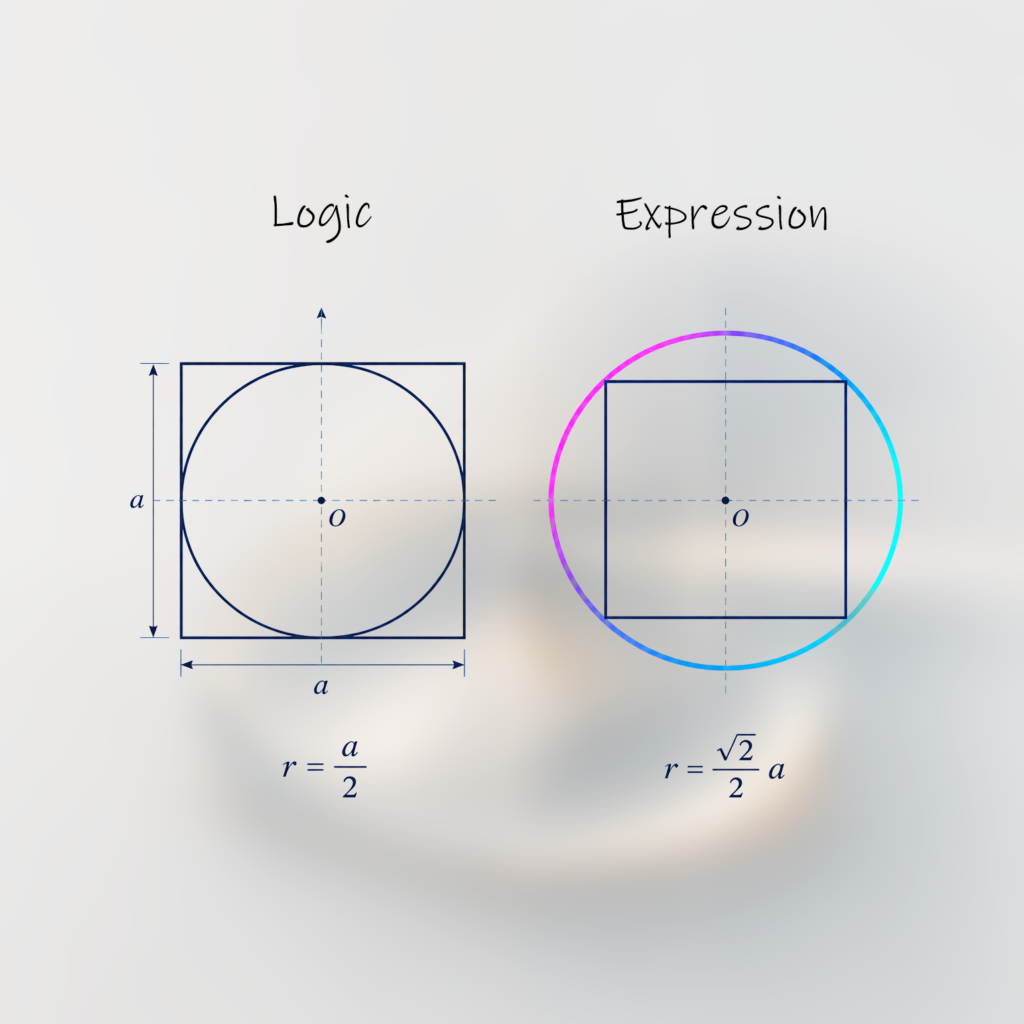
Logic & Expression
A square of side a establishes the fundamental boundary.
Logic📐: An inscribed circle with
remains entirely within the defined domain. It represents technical discipline: a system optimized for balance, symmetry, precision, and complete containment within fixed limits.
Expression🌈: A circumscribed circle with
extends beyond the domain while remaining geometrically anchored to its four vertices. It represents artistic expression: a state that transcends the boundary without abandoning mathematical rigor.
The chromatic gradient introduces a continuous spectrum into the otherwise static geometry—transforming mathematical structure into a field of visual possibility.
Logic seeks perfection within the boundary, Expression carries that perfection beyond it.
The distinction between technology and art, therefore, is not the presence or absence of logic. It is the way logic is used: to establish a limit, or to transcend it.
Logic gives form, Expression transcends the boundary.
-
[Ad]
-
☔️
Unbeaten by rain.
Unbeaten by wind.
Snow and summer heat can’t touch me.Strong body.
No wants.
Never mad.
Quiet smile, always.Four bowls of rice a day.
A little miso, a few vegetables.Leave yourself out.
Look, listen, get it.
Don’t forget.A small hut under the pines in the field.
East, a sick kid: go take care.
West, a tired mother: go carry her rice.
South, someone dying: tell them don’t worry.
North, a stupid fight: tell them to quit it.Crying in the dry heat.
Lost in a cold summer.They call me a fool.
No applause.
No complaints.That’s who I want to be.
Kenji Miyazawa, Ame ni mo Makezu (雨ニモマケズ), 1931.

-
🧿
-
🤚